Gennon
Notable figures

Feng Ta'Shihr
Monarch of Gennon and one of the great consolidators of Ta'Shihr power. Feng unified the tribes, formalized courtly and military customs, and taught Viktor the ancestral forge-lore preserved from Tython.
.png)
Viktor
Outsider, former slave, and the first great High Knight of Gennon. His severe armor and hooded visage came to symbolize the knightly order’s harsh discipline, martial strength, and service to the Ta'Shihr throne.
History

The ancestors of House Ta'Shihr were Force-sensitive exiles tied to the Je'daii era who fled the Tython sphere and journeyed into the unknown Deep Core. They eventually reached Gennon, where they settled among the native tribes and became known as the Sorcerers of Bogan.
The Ta'Shihr line established a monarchy that blended tribal authority, bloodline legitimacy, and the ancient Bogan tradition. Under Feng Ta'Shihr, the warrior castes were reorganized and bound by oaths of loyalty, and the High Knights emerged as an elite order in formal service to the throne.
Viktor, an outsider from the Empress Teta system, rose from slavery in Gennon's iron quarries to become the first High Knight. Later, the Rakatan Force Hound Cresh arrived on the world, bringing outside influence and new knowledge that reshaped the High Knights and expanded Gennon's understanding of the wider galaxy. In later prophecy and myth, Viktor was also remembered as a protector figure tied to the deeper fate of Gennon itself, with some traditions identifying him as the one who must hold firm if the wound beneath the world was not to open.
Culture and government
Gennonite culture combined monarchy, tribal identity, martial ritual, and ancestral reverence. The Ta'Shihr rulers served as both monarchs and spiritual authorities, while local clan traditions remained powerful across the world.
Force traditions
The Gennonite Bogan tradition emphasized instinct, emotional truth, ancestral resonance, and disciplined strength. It developed independently from both the Je'daii and later Sith, though later rulers such as Sydrian Ta'Shihr merged older Bogan practices with Sith teachings.
Connection to the Maw

Certain Gennonite prophecies, Ta'Shihr records, and later Je'daii-derived theories held that Gennon stood upon or near the Black Meridian, a Force-sensitive faultline linked to the wider Deep Core disturbances surrounding the Maw. In these traditions, Gennon was not merely a harsh and isolated world, but a stabilizing point whose continued integrity helped suppress more catastrophic unrest tied to the prison of Abeloth.
Some versions of this tradition described Gennon as an anchor point or seal-world, shaped to absorb, ground, and diffuse Force turbulence spilling from the Maw. Later myths preserved by House Ta'Shihr referred to the world as the iron hinge upon a prison door, while older warnings spoke of a “wound beneath Gennon” that would awaken if its guardian failed.
A related tradition claimed that an early Ta'Shihr ancestor, sometimes identified as Kavor Ta'Shihr, discovered the truth of Gennon’s connection to the Maw and deliberately corrupted Deep Core records to keep the Je'daii and other outside powers from locating the world. By this account, Gennon’s long isolation was not merely geographic, but intentional.
Black Meridian studies
Later Ta'Shihr scholars, Meridian Watch observers, and occult interpreters treated the Black Meridian not merely as a geological anomaly, but as a deeper fracture in the spiritual fabric of the Deep Core. Study traditions held that the faultline pulsed in sympathy with hidden mass shadows, ancient imprisoning mechanisms, and older structures tied to the Maw.
Some surviving diagrams and speculative records depicted the Black Meridian as a chain of stress points or seal-nodes rather than a single wound, with Gennon serving as one of the most stable and burdened points in that hidden structure. These theories were never uniformly accepted, but they heavily influenced later Ta'Shihr prophecy, Meridian Watch doctrine, and the language used to describe Gennon as a world that must not fail.


In the most esoteric interpretations, these studies were used to argue that Gennon did not simply lie near the Black Meridian, but had been deliberately shaped, settled, hidden, or preserved because of it. Whether this was Celestial design, later misreading, or a truth half-lost under generations of fear and secrecy remained a matter of debate.
Military
The High Knights of Gennon were an elite warrior order serving the Ta'Shihr monarchy. Their armor, blades, and rituals reflected both local metallurgy and ancient Force-forging traditions preserved from the Dawn of the Jedi era.
Settlements and sites
Meridian Watch was Gennon’s most secretive center of study, later developing into an orbital station devoted to the observation of the Black Meridian and the strange Force turbulence surrounding it. Over time, its purpose expanded beyond observation alone. Scholars, Ta'Shihr adepts, alchemists, and seekers of forbidden knowledge used Meridian Watch to examine ancient records, Celestial traces, Rakatan artifacts, Force-forged metallurgy, and esoteric rites tied to the deeper mysteries of the Deep Core. To some, it was a place of wisdom. To others, it was where Gennon’s rulers learned how to turn dread into advantage.
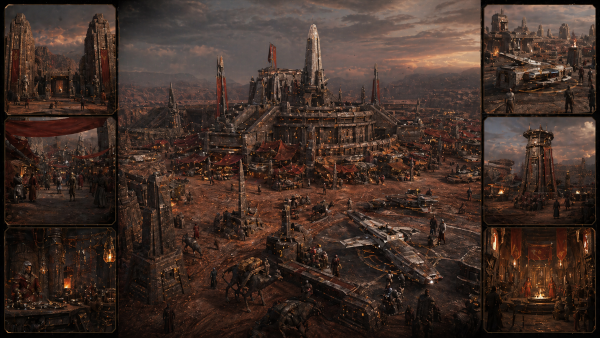
The Red Bazaar served as Gennon’s chief trade settlement and contact point with outsiders. Built at the edge of harsher lands and stained by dust, ore, and old blood-colored stone, it was a place where caravans, ore merchants, smiths, offworld traders, smugglers, and royal agents met under wary eyes. Though trade there was tightly watched by the Ta'Shihr monarchy, the Bazaar gained a reputation as one of the few places on Gennon where foreign goods, whispered rumors, and dangerous bargains passed from hand to hand.
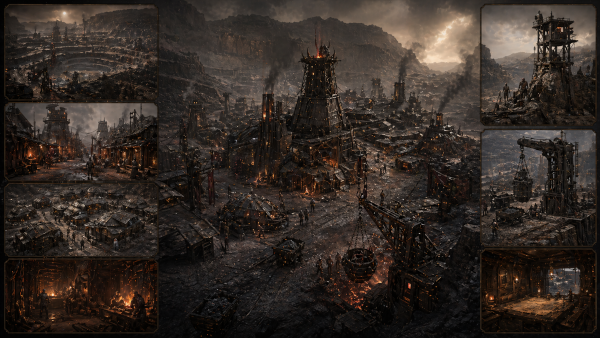
Iron Town was the brutal workers’ settlement clustered around Gennon’s great iron quarries. Home to quarry laborers, slaves, pit fighters, smiths, and the families of those who survived the harsh industrial frontier, it was one of the hardest places on the planet. Smoke, iron dust, and the sound of hammering defined daily life there. Though dismissed by nobles as rough and coarse, Iron Town was vital to Gennon’s strength, for its ore fed the forges that armed the High Knights and sustained the metalwork of the realm.
Points of interest
- Ta'Shihr Castle
- Meridian Watch
- The Red Bazaar
- Iron Town
- Fighting pits
- Black Meridian faultline
Notable flora and fauna
Notable individuals
- Feng Ta'Shihr
- Viktor
- Cresh
- Sydrian Ta'Shihr
- Mattis Ta'Shihr
- Bowen
- Kavor Ta'Shihr
Behind the scenes
Gennon was originally conceived by Sydrian Ta'Shihr as a fan-created Deep Core world. Over time, the setting was further developed and woven into Dawn of the Jedi-era lore through connections to the Je'daii, Bogan traditions, the Infinite Empire, the Black Meridian, and the wider Ta'Shihr legacy.